News
NASA's IBEX Discovers ENAs at Edge of Earth's Magnetopause
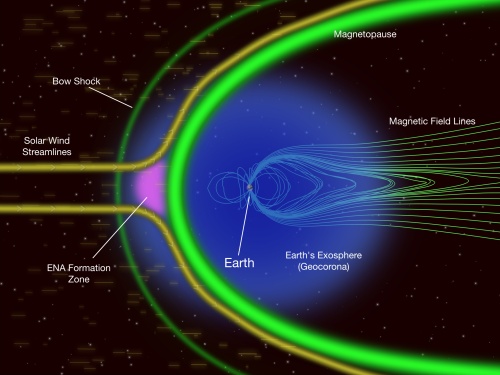
Imagine floating 35,000 miles above the sunny side of Earth. All seems calm around you. With no satellites or space debris to dodge, you can just relax and enjoy the black emptiness of space. But looks can be deceiving. In reality, you've unknowingly entered into a dimension of sound... A dimension of sight... A dimension of mind... You've just crossed into... the ENA Zone - the place in space where a supersonic "wind" of charged particles from the Sun crashes head-on into the protective magnetic bubble that surrounds our planet. Traveling at a million miles per hour, the solar wind's protons and electrons sense Earth's magnetosphere too late to flow smoothly around it. Instead, they're shocked, heated, and slowed almost to a standstill as they pile up along the outer boundary of the magnetopause forming Energetic Neutral Atoms, or ENAs. That's what NASA's Interstellar Boundary Explorer (IBEX) has just discovered.
International Scientific Panel: Asteroid Killed Off the Dinosaurs - Case Closed
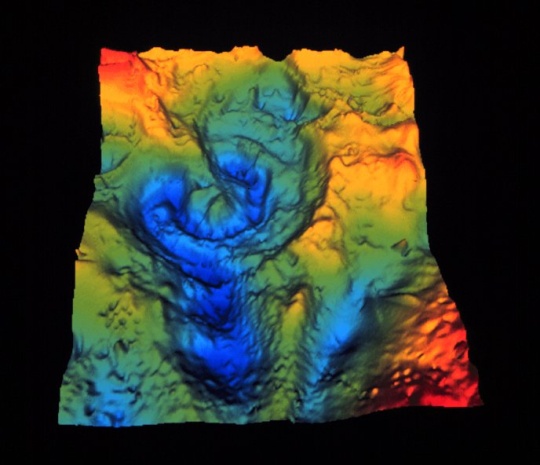
The Cretaceous-Tertiary mass extinction, which wiped out the dinosaurs and more than half of species on Earth, was caused by an asteroid colliding with Earth and not massive volcanic activity, according to a comprehensive review of all the available evidence according to a panel of 41 international experts. The scientists reviewed 20 years' worth of research to determine the cause of the Cretaceous-Tertiary (KT) extinction, which happened around 65 million years ago. The extinction wiped out more than half of all species on the planet, including the dinosaurs and large marine reptiles, clearing the way for mammals to become the dominant species on Earth.
NJIT's Big Bear Observatory Resolves to 50 miles of the Sun's Surface

New Jersey Institute of Technology's Big Bear Solar Observatory (BBSO) has achieved "first light" with an new adaptive optics deformable mirror telescope. Images of a sunspots, the most detailed ever obtained in visible light, were released to showcase its resolution. The images were made with the 1.6 meter clear aperture, off-axis New Solar Telescope (NST), which has a resolution covering about 50 miles of the Sun's surface.
Low Solar Activity Linked to Changes in Sun's Conveyor Belt
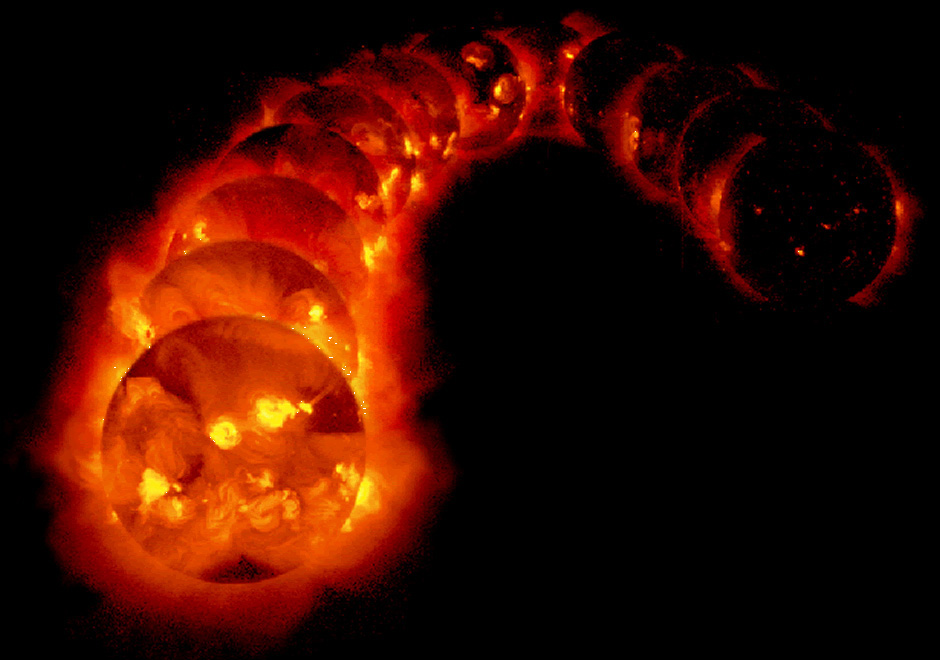
A new analysis of the unusually long solar cycle that ended in 2008 suggests that one reason for the long cycle could be a stretching of the sun's conveyor belt, a current of plasma that circulates between the sun's equator and its poles. The sun goes through cycles lasting approximately 11 years that include phases with increased magnetic activity, more sunspots, and more solar flares, and phases with less activity. The results of this study should help scientists better understand the factors controlling the timing of solar cycles and could lead to better predictions.
Did Life on Earth Start Between the Sheets... Of Mica that is?

That age-old question, "Where did life on Earth start?" now has a new possible answer. There are several lines of evidence that support the idea that life originated with molecules that lay between mica sheets. The life between the sheets mica hypothesis was developed by Helen Hansma of the University of California, Santa Barbara (UCSB). If the "life between the sheets" mica hypothesis is correct, life would have originated between sheets of mica that were layered like the pages in a book.
ESO Astronomers Challenge Current Theories of Black Hole Formation
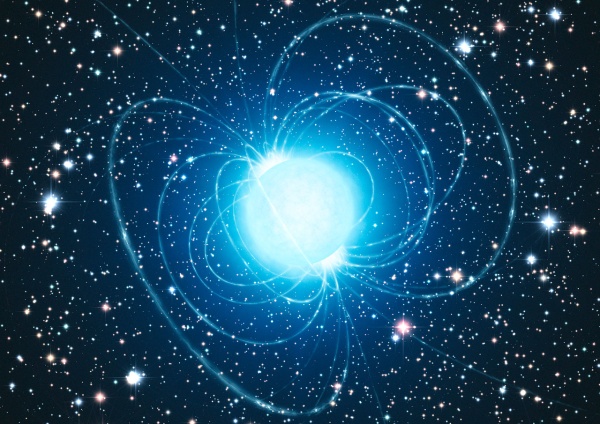
Using ESO's Very Large Telescope, European astronomers have for the first time demonstrated that a magnetar — an unusual type of neutron star — was formed from a star with at least 40 times as much mass as the Sun. The result presents great challenges to current theories of how stars evolve, as a star as massive as this was expected to become a black hole, not a magnetar. This now raises a fundamental question: just how massive does a star really have to be to become a black hole?
Fermilab Experiments Start to Close in on the Elusive Higgs Boson
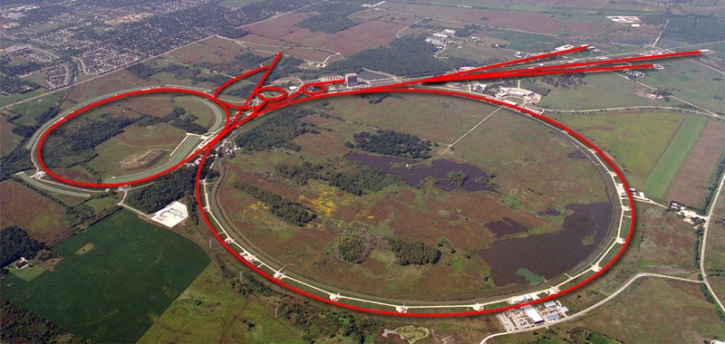
New constraints on the elusive Higgs particle are more stringent than ever before. Scientists of the CDF and DZero collider experiments at Fermilab revealed their latest Higgs search results that rule out a significant fraction of the allowed mass range established by earlier experiments. The Large Hadron Collider (LHC) experiments at CERN, which record proton-proton collisions that have 3.5 times the energy of Tevatron collisions, are also looking for the elusive Higgs boson. But for rare subatomic processes such as the production of a Higgs particle with a low mass, extra energy is less important than a large number of collisions produced. With the Tevatron cranking out more and more collisions, Fermilab has a good chance of catching a glimpse of the Higgs boson.
Einstein@Home Volunteers Discover New Radio Pulsar
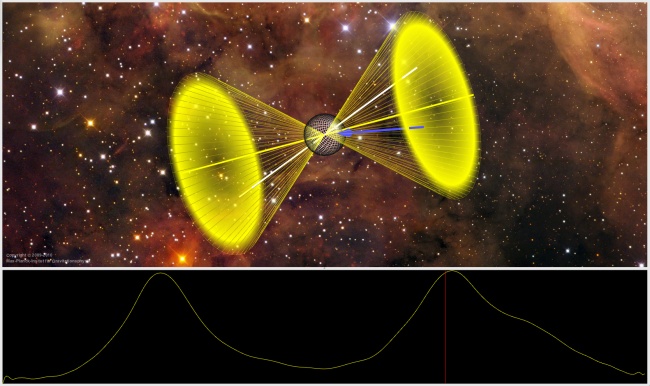
Three citizen scientists, a German and an American couple, have discovered a new radio pulsar hidden in data gathered by the Arecibo Observatory. This is the first deep-space discovery by Einstein@Home, which uses donated time from the home and office computers of 250,000 volunteers from 192 different countries.
Studying a Stellar Explosion in 3D
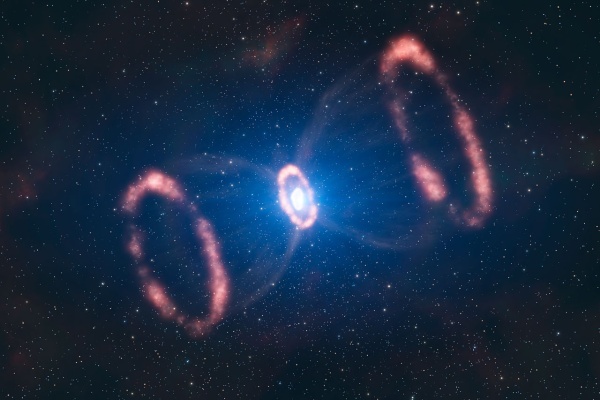
Astronomers using ESO's Very Large Telescope have for the first time obtained a three-dimensional view of the distribution of the innermost material expelled by an exploding star. The original blast was not only powerful, according to the new results, it was also more concentrated in one particular direction. New observations making use of a unique instrument on ESO's Very Large Telescope (VLT) have provided even deeper knowledge of this amazing event, as astronomers have now been able to obtain the first-ever 3D reconstruction of the central parts of the exploding material, which was ejected at an incredible 100 million km per hour or about a tenth of the speed of light.
Astro Coffee!

Finally coffee made by astronomers FOR astronomers.
Where Oh Where Has My Rover Gone?

NASA mission controllers have not heard from the Mars Exploration Rover Spirit since March 22, 2010 and the rover is facing its toughest challenge yet - trying to survive the harsh Martian winter. NASA believes that Spirit has gone into a low-power hibernation mode. The rover was not able to get to a favorable sun-facing slope for its fourth Martian winter after getting stuck in the sand. The low angle of sunlight during the winter months limits the power generated from the rover's solar panels. Now there is a very distinct possibility that Spirit may never respond.
Turning Planetary Theory Upside Down
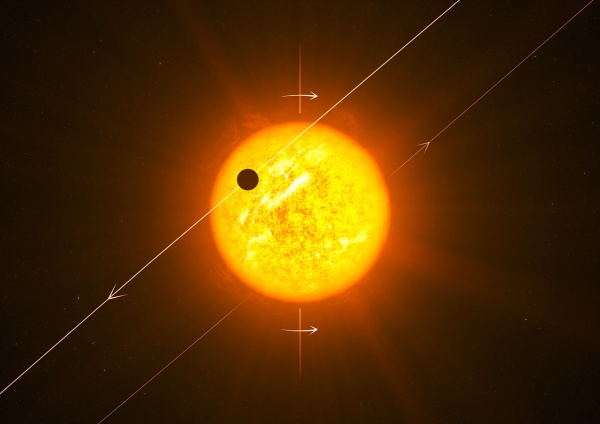
With the discovery of a new batch of transiting exoplanets, astronomers were surprised to find that 6 out of 27 were found to be orbiting in the opposite direction to the rotation of their host star — the exact reverse of what is seen in our own Solar System. The new discoveries provide an unexpected and serious challenge to current theories of planet formation. They also suggest that systems with exoplanets of the type known as "Hot Jupiters" are unlikely to contain Earth-like planets.
Hypervelocity Star Surpasses Escape Velocity of the Milky Way Galaxy
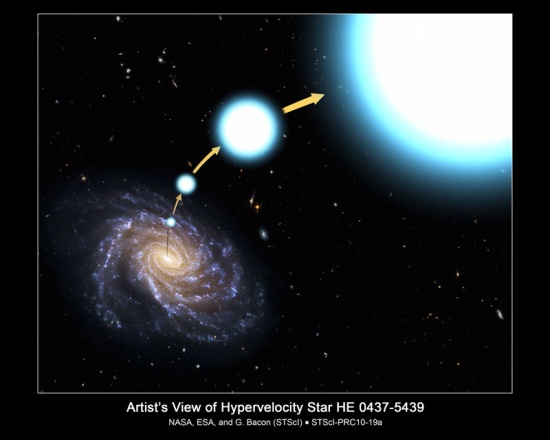
A hundred million years ago, a triple-star system was traveling through the bustling center of our Milky Way galaxy when it made a wrong turn. The trio wandered too close to the galaxy's giant black hole, which ate one of the stars and hurled the other two out of the Milky Way. This story may sound like a fairy tale, but astronomers using NASA's Hubble Space Telescope say it is the most likely scenario for a so-called hypervelocity star known as HE 0437-5439, one of the fastest ever detected. It's blazing across space at a speed of 1.6 million miles an hour and is cruising high above the galaxy's disk, about 200,000 light-years from the center. For comparison, the Milky Way's disk is approximately 100,000 light-years in diameter.
New Class of Supernovae Puts Calcium in Our Bones
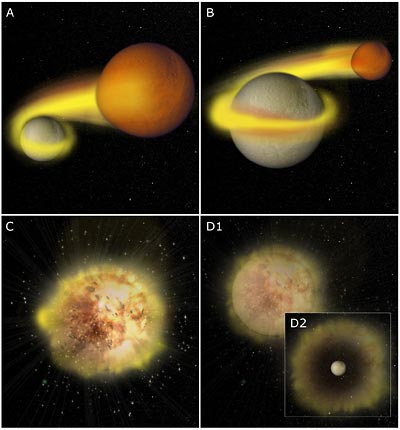
In the past decade, robotic telescopes have turned astronomers' attention to many strange exploding stars -- one-offs that may or may not point to new and unusual physics. But supernova (SN) 2005E, discovered five years ago by the University of California, Berkeley's Katzman Automatic Imaging Telescope (KAIT), is one of eight known "calcium-rich supernovae" that seem to stand out as horses of a different color. These calcium-rich supernovae may be a true suborder and not just one of a kind.
UK Researchers Discover the Most Massive Star Ever Found
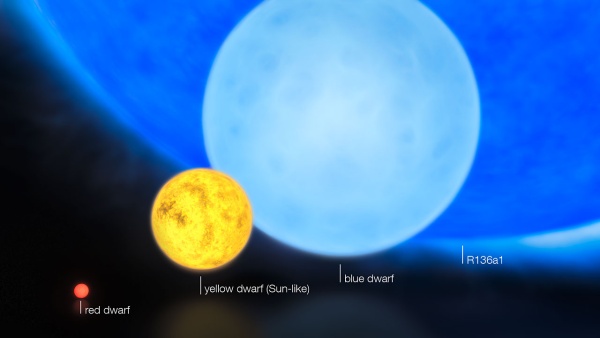
Researcher at the University of Sheffield in the UK have discovered the most massive star ever found, using the European Southern Observatory (ESO) Very Large Telescope. The star, R136a1, weighs up to 265 times the mass of the Sun, a figure that doubles the previously accepted limit of solar mass.
Funding Member
