News
Happy Birthday NASA - 50 Years of the Right Stuff

As the men and women of the National Aeronautics and Space Administration celebrate its 50th anniversary this month, Defense Department personnel also can take a bow for the key role they have played in lending technology and expertise to NASA's space exploration and research missions, according to Donna Miles of the American Forces Press Service.
New Fermi Space Telescope Discovers Gamma Ray Spewing Pulsar

The newest major space observatory, the Fermi Gamma-ray Space Telescope, launched into orbit on June 11, 2008, has made its first major discovery -- a new class of pulsars that emits only Gamma Rays.
Colossal Black Holes Common in the Early Universe
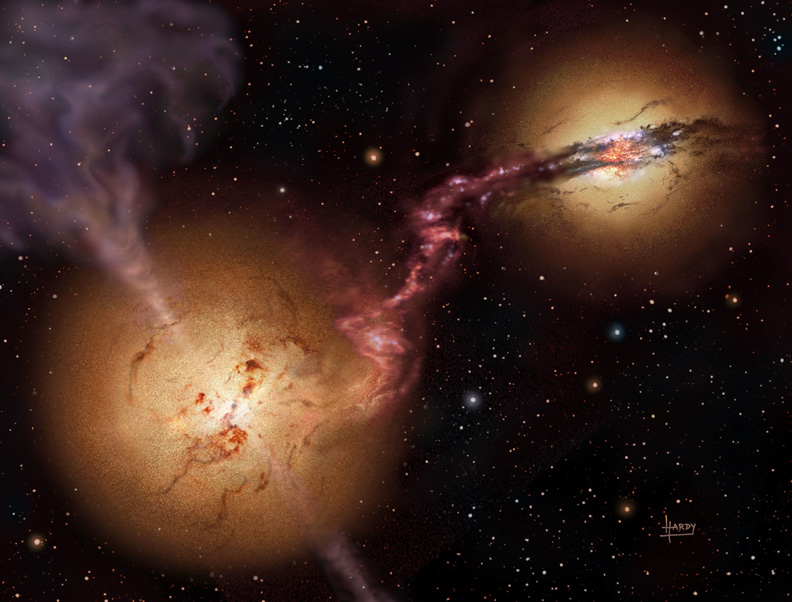
Astronomers think that many - perhaps all - galaxies in the universe contain massive black holes at their centers. New observations with the Submillimeter Array now suggest that such colossal black holes were common even 12 billion years ago, when the universe was only 1.7 billion years old and galaxies were just beginning to form. The new conclusion comes from the discovery of two distant galaxies, both with black holes at their heart, which are involved in a spectacular collision.
NASA Plans to Build Giant Liquid Telescopes on the Moon
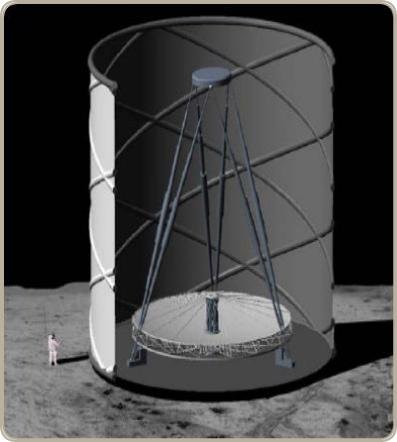
A team of internationally renowned astronomers and researchers have found a way to make "unbelievably large" telescopes on the Moon. Someday, astronauts on the moon may pour liquid onto a disc-shaped mesh to make a huge mirror for a powerful telescope. The liquid would include a silver-coated surface and would be part of an optical-infrared telescope with a 66-foot (20-meter) to 328-foot (100 meter) aperture capable of observing objects 100 to 1,000 times fainter than the James Webb Space Telescope.
ASTEROID 2008 TC3
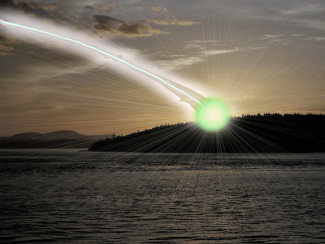
Asteroid to Hit Earth?
MESSENGER Returns Images from Oct. 6 Mercury Fly-By
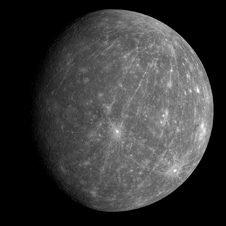
MESSENGER is the first mission sent to orbit the planet closest to the sun. On Oct. 6, 2008, at roughly 4:40 a.m. ET, MESSENGER flew by Mercury for the second time this year.
Let it Snow, Let it Snow, Let it Snow...

NASA's Phoenix Mars Lander has detected snow falling from Martian clouds -- a clear sign that Martian Winter is approaching. The Phoenix mission, originally planned for three months on Mars, now is in its fifth month. However, it faces a decline in solar energy that is expected to curtail and then end the lander's activities before the end of the year.
Action urged on asteroids

Astronauts and other space experts are calling for the formation of new international organizations to monitor a threat that may not be as imminent as the current financial crisis but would be even more catastrophic: a cosmic collision with an asteroid or comet.
Discovery of a New Milky Way Arm Adds to Galaxy's Beauty and Symmetry
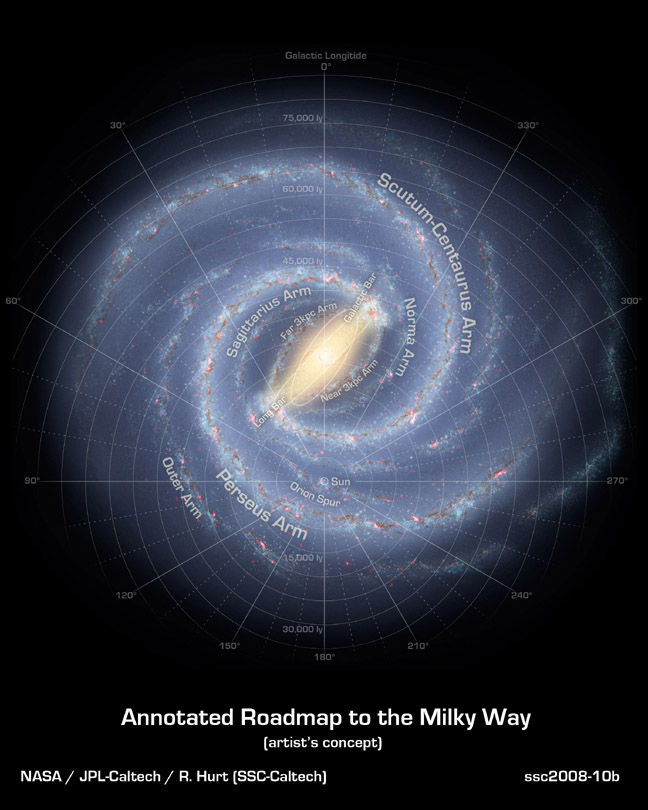
Astronomers have worked for decades to map the Milky Way and its spiral arms. They have just discovered a new spiral arm on the far side of the galactic center from Earth, which is a virtual twin of a known arm on the near side of the galactic center. The Milky Way therefore shows a beautiful symmetry, with two matching spiral arms spinning near the galaxy's center.
Gemini North Captures First Picture of Likely Planet Around a Sun-like Star
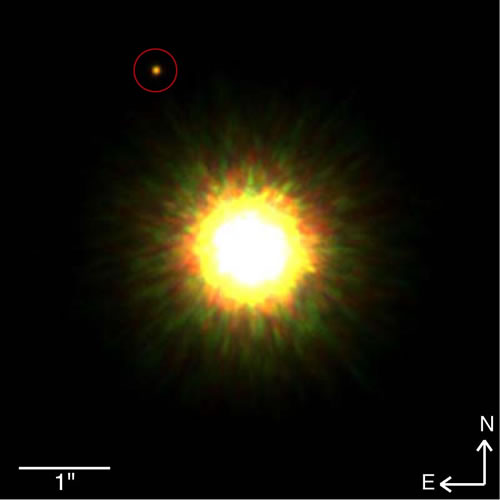
University of Toronto astronomers using the Gemini North telescope have unveiled what is likely the first picture of a planet around a star similar to the Sun.
Astrophysicists Discover Upper Limit to the Size of Supermassive Black Holes
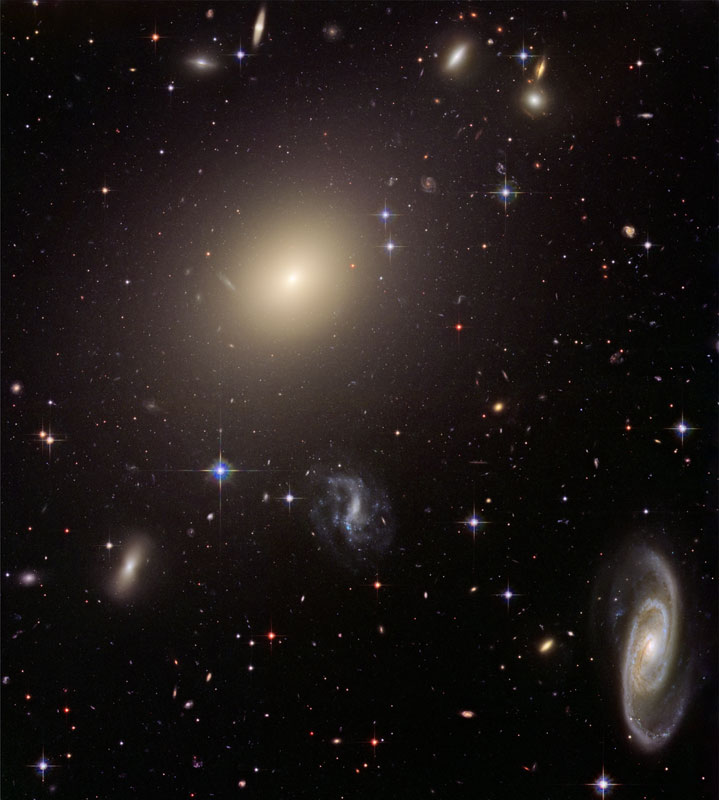
Once considered rare and exotic objects, black holes are now known to exist throughout the universe, with the most massive found at the centers of the largest galaxies. Now there appears to be an upper limit to how big the universe's most massive black holes can get, according to new research by astrophysicists from the University of Hawaii and Yale University. This limit is 10 billion times the mass of the Sun.
Hubble Finds Monster Magnetic Filaments in Nearby Galaxy
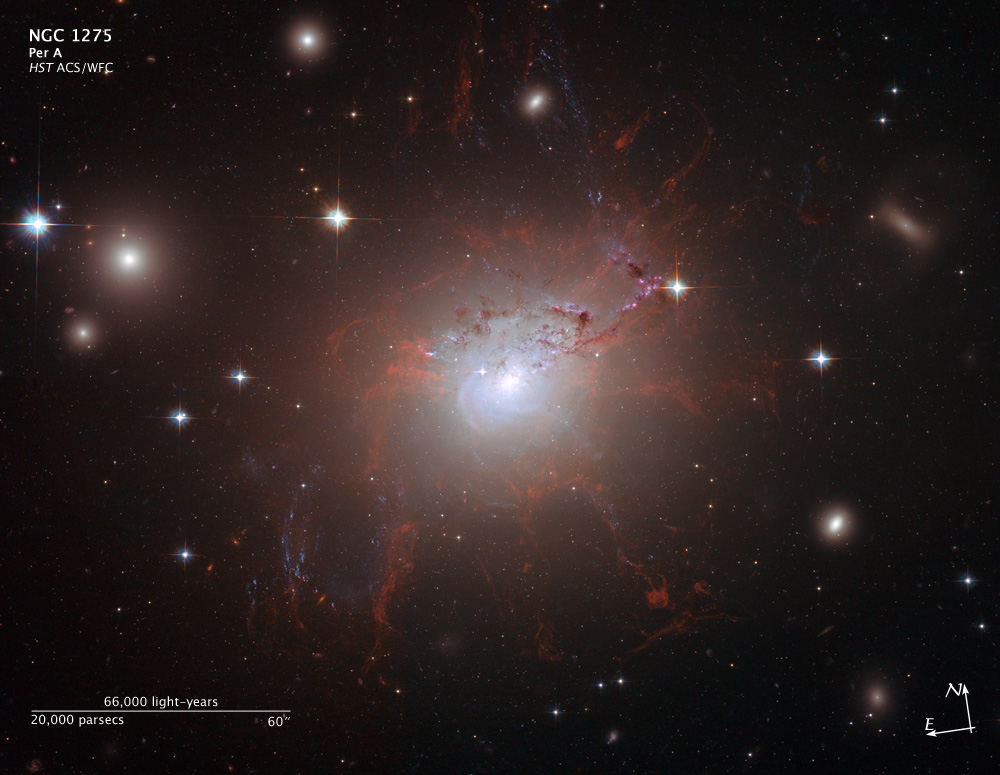
NASA's Hubble Space Telescope has found an answer to a long-standing puzzle by resolving giant but delicate filaments shaped by a strong magnetic field around the active galaxy NGC 1275. It is the most striking example of the influence of the immense tentacles of extragalactic magnetic fields.
Thirty Years into its Journey - Voyager 2 Crosses the Termination Shock

Voyager 2 reached a new landmark when it crossed and then left behind the termination shock at the edge of the solar system. This makes Voyager 2 only the second spacecraft known to have passed through this turbulent region, following its twin, Voyager 1. Voyager 2 has passed beyond the heliosphere and into the heliosheath. The next stop is the heliopause, marking the outer boundary of the Sun's influence and the true beginning of interstellar space. More than 30 years after its launch Voyager 2 is still a source of invaluable scientific data.
Beam Me Up Scotty - Cloaking Technology One Step Closer to Reality
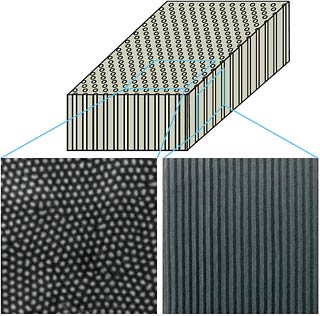
Scientists at the University of California, Berkeley, have engineered three-dimensional metamaterials that can reverse the natural direction of visible light, which could one day lead to an invisibility device. The material is composed of parallel nanowires embedded inside porous aluminum oxide. As visible light passes through the material, it is bent backwards in a phenomenon known as negative refraction. While the researchers welcome these new developments in metamaterials at optical wavelengths, they also caution that they are still far off from invisibility cloaks and other applications that may capture the imagination.
Jupiter and Saturn Composed of Liquid Helium and Hydrogen Metal Alloy

A strange metal brew lies buried deep within Jupiter and Saturn, according to a new study by researchers at the University of California, Berkeley, and in London. The study demonstrates that metallic helium is less rare than was previously thought and is produced under the kinds of conditions present at the centers of giant, gaseous planets, mixing with metal hydrogen and forming a liquid metal alloy.
Funding Member
