News
Has Moore's Law Finally Reached its Limits?

Researchers have used the world's thinnest material, Graphene, to create the world's smallest transistor -- one atom thick and ten atoms wide. Does this achievement signal the the limit to how small semiconductors can become?
Candidates and the Space Race

WASHINGTON (CNN) -- One issue the presidential candidates are not saying much about is space exploration. But some scientists, military experts and intelligence analysts say the next president may well determine whether America keeps an edge in space.
NRAO's Very Long Baseline Array Reveals Secrets of SuperMassive Black Hole

At the cores of many galaxies, supermassive black holes expel powerful jets of particles at nearly the speed of light. Just how they perform this feat has long been one of the mysteries of astrophysics. Using the unrivaled resolution of the National Radio Astronomy Observatory's Very Long Baseline Array (VLBA), astronomers have watched material winding a corkscrew path outward from a supermassive black hole and behaving exactly as predicted by theory.
OffOrbit.TV Premiers with Fascinating Look at Solar Imaging
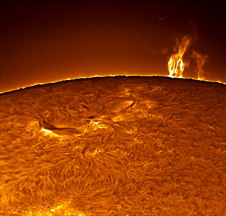
Most backyard astronomers wait for dark to observe, but one of most spectacular objects in the sky is right in front of us every day. Observing the sun through telescopes requires care and knowledge, and when you bring the enthusiasm and skill of Greg Piepol into the mix, well unbelievable views of our very own star are the result. Join OffOrbit.TV in its premier edition to explore what strange and beautiful images are possible right from your backyard.
NJIT to Unveil World's Largest Solar Telescope at Big Bear

During the next decade, solar physicists will learn more than they have dreamed possible about the Sun, thanks to current technologies that have advanced the capacity of land-based solar observatories. New Jersey Institute of Technology (NJIT) has led the effort to build the world’s largest and most capable solar telescope at Big Bear Solar Observatory (BBSO). Scheduled for first light in Jume 2008, the 1.6-meter NJIT solar telescope will surpass the current record holder - a 1-meter solar telescope operating on La Palma in the Canary Islands.
Astronomers Find the Coldest Brown Dwarf Star Ever Observed

An international team of astronomers has discovered the coldest brown dwarf star ever observed. This finding is a new step toward filling the gap between stars and planets. It appears that there is not much difference between cold Brown Dwarfs like the one discovered here and giant heat radiating gaseous planets like Jupiter.
Cassini Discovers Rings Around Saturn's Moon Rhea

Researchers using NASA’s Cassini spacecraft have found evidence of material orbiting Rhea, Saturn's second largest moon. This finding is the first time that rings have been found around a moon.
Mars Reconnaissance Orbiter Images Phobos in Color and in 3D
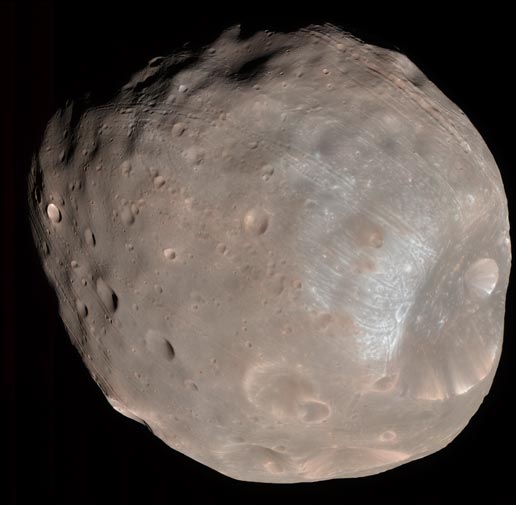
A new stereo view of Phobos, the larger of Mars' two tiny moons, has been captured by the Mars Reconnaissance Orbiter, a NASA spacecraft orbiting Mars. The new view shows landslides along the walls of large craters. Also captured were Phobos' striking surface grooves and crater chains and craters hidden on the moon's dark side illuminated by "Mars-shine."
Omega Centauri Globular Cluster May Hide a Black Hole at its Center
Omega Centauri has been known as an unusual globular cluster for a long time. The NASA/ESA Hubble Space Telescope and the Gemini Observatory reveal that the explanation behind Omega Centauri’s peculiarities may be a black hole hidden in its centre. One implication of the discovery is that Omega Centauri may not be a globular cluster at all, but rather a dwarf galaxy stripped of its outer stars.
Startling Image of a Supreme Being?
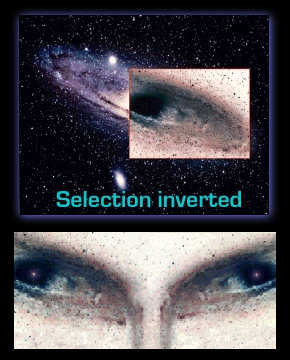
Does our nearest galactic neighbor harbor a big secret
A Gamma Ray Burst 7.5 Billion Light Years Away Visible with the Naked Eye

A powerful Gamma Ray Burst (GRB) detected on March 19, 2008 by NASA's Swift satellite in the constellation Boötes has shattered the record for the most distant object that could be seen with the naked eye. GRBs are the most luminous explosions in the universe since the big bang and this one occurred halfway across the visible universe.
University of Arizona Begins Casting Mirrors for LSST
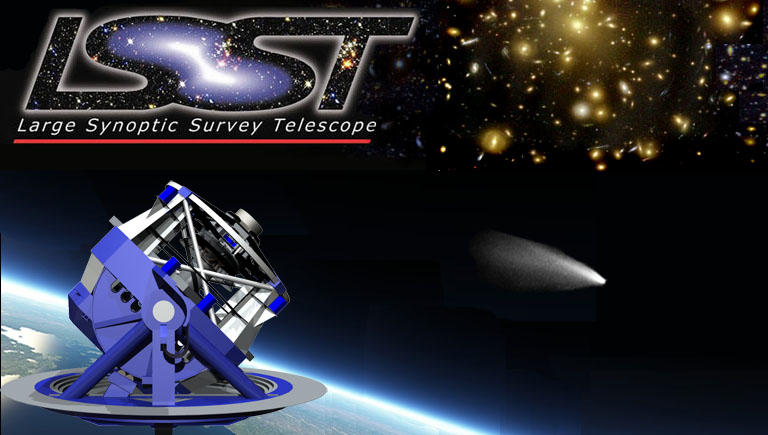
The University of Arizona's Steward Observatory Mirror Laboratory has begun casting a new kind of giant mirror for a unique wide-field survey telescope, the Large Synoptic Survey Telescope (LSST). On track to see first light in 2014, the telescope will be the widest, fastest, deepest eye on the sky and will provide time-lapse digital imaging of the entire visible night sky every three days. Continuous images will be recorded every 15 seconds by a high resolution 3.2 billion-pixel camera.
The 2nd Amendment is on the clock

The DC showdown. For interested parties.
Spitzer Finds Simple Organic Gases and Water Vapor Around an Infant Star
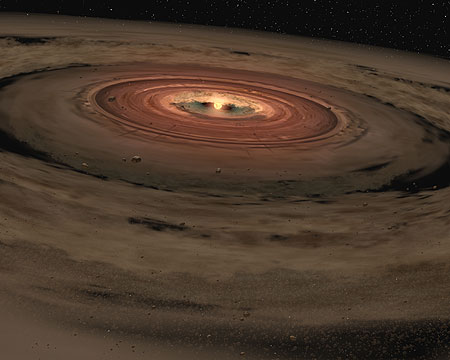
Researchers using NASA's Spitzer Space Telescope have discovered large amounts of simple organic gases and water vapor in a possible planet-forming region around an infant star, along with evidence that these molecules were created there. They've also found water in the same zone around two other young stars.
2008/03/12 07:00
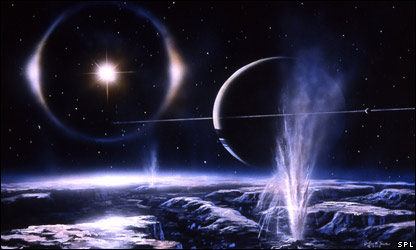
The flyby will take the probe through the plumes of icy particles emanating from the enigmatic cracks at the south pole dubbed the "tiger stripes". The cause of this activity has developed into the big scientific question of the flagship mission. The pass will allow Cassini instruments to directly sample the plume particles. This should help scientists address the tantalising issue of whether there is an ocean under Enceladus' icy crust.
