News
Julian Starfest is Born

An idea created with good "spirits"! Once we started spreading the word about Julian Starfest, the excitement grew. We’ve gotten a lot of enthusiasm from the astronomical community, and guest speakers are lining up to speak during the day. At this time, our speaker line-up includes Scott Kardel of Palomar, Lisa Bruhn of the IDA, Dr. Paul Etzel of Mount Laguna Observtory, and many more.
Phoenix Mars Lander Confirms Frozen Water... (Or So That's What the White Stuff is)

Scientists confirm the presence of water ice near the surface near NASA's Phoenix Mars Lander and anticipate even bigger discoveries from the robotic mission in the weeks ahead. Is it possible that the Martian ice caps that we have been observing all these years from our backyards is really ice? Apparently so.
Arecibo Joins Global Network to Create 6,800-mile Diameter Radio Telescope

Arecibo Observatory in Puerto Rico joined other telescopes in North America, South America, Europe, and Africa in simultaneously observing the same targets, simulating a telescope more than 6,800 miles (almost 11,000 kilometers) in diameter. The telescopes are all members of the Express Production Real-time eVLBI Service project. This marked a live demonstration of the first four-continent, real-time, electronic Very Long Baseline Interferometry (eVLBI) observation. eVLBI can generate images of cosmic radio sources with up to 100 times better resolution than images from the best optical telescopes.
Con-CERNs About the Large Hadron Collider

CERN is just weeks away from firing up the Large Hadron Collider (LHC). LHC is most powerful particle accelerator ever built. LHC will recreate, on a micro-scale, conditions that existed billionths of a second after the birth of our Universe. LHC will accelerate heavy lead particles to almost the speed of light and then smash them together head on. Many researchers are excited about the possible new discoveries that will result from this experiment. Others are concerned that this is a very dangerous experiment because at such high energies, the conversion of energy to mass could create miniature black holes or a theorized form of exotic matter called Strangelets.
Two of the Milky Way's Spiral Arms Go Missing
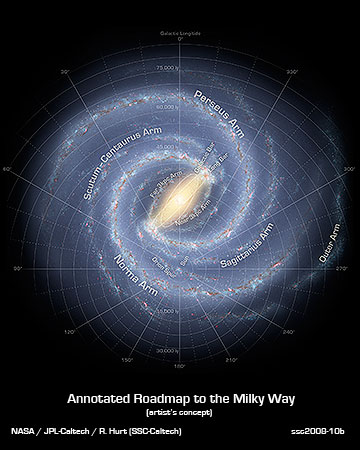
For decades, astronomers have been blind to what our galaxy, the Milky Way, really looks like. After all, we sit in the midst of it and can't step outside for a bird's eye view....
Did Modern Humans Evolve at Least Partialy from Neanderthals?

The expansion of pre-modern humans into western and eastern Europe 40,000 years ago led to the eventual replacement of the Neanderthals by modern humans 28,000 years ago. Did modern humans evolve at least partly from Neanderthals? Or are modern humans on a completely separate evolutionary path? Did Neanderthals and early modern humans interbreed? Perhaps Neanderthals and humans mated and produced sterile offspring, similar to mules, the crossbreed of horses and donkeys. Researchers working with recovered DNA samples are just now reaching some interestig conclusions.
NASA's Phoenix Spacecraft Lands on Mars
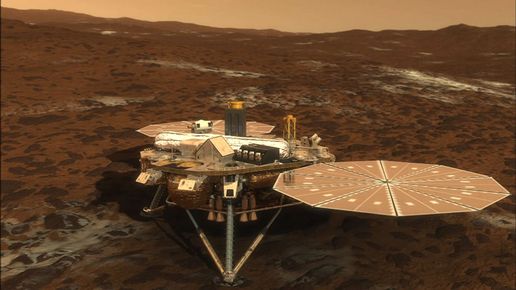
NASA's Phoenix spacecraft landed in the northern polar region of Mars today to begin three months of examining a site chosen for its likelihood of having frozen water within reach of the lander's robotic arm. The next few days will be critical as the spacecraft confirms that the masts for the stereo camera and the weather station have swung to their vertical positions. Initial attempts will be made to move the 7.7-foot-long robotic arm, which will be used in the next few weeks to get samples of soil and ice into laboratory instruments on the lander deck.
Princeton University Astronomers Capture a Supernova Just as it Explodes
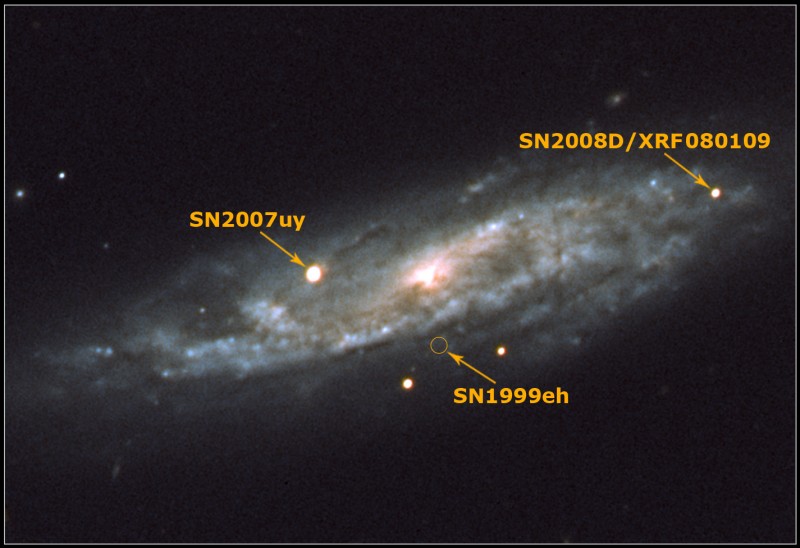
Supernovae are fascinating to researchers because in the destruction of their progenitor and in their own creation, all the elements in the universe are produced and injected into galaxies. Two Princeton University astronomers using NASA's Swift satellite became the first to catch a Supernova (SN 2008D) in the act of exploding. This once-in-a-lifetime event has transfixed the worldwide astronomical community because the Supernova was captured as the initial X-rays exploded and just before the optical light was visible.
The Mouse That Roared: Pipsqueak Star Unleashes a Monster Flare
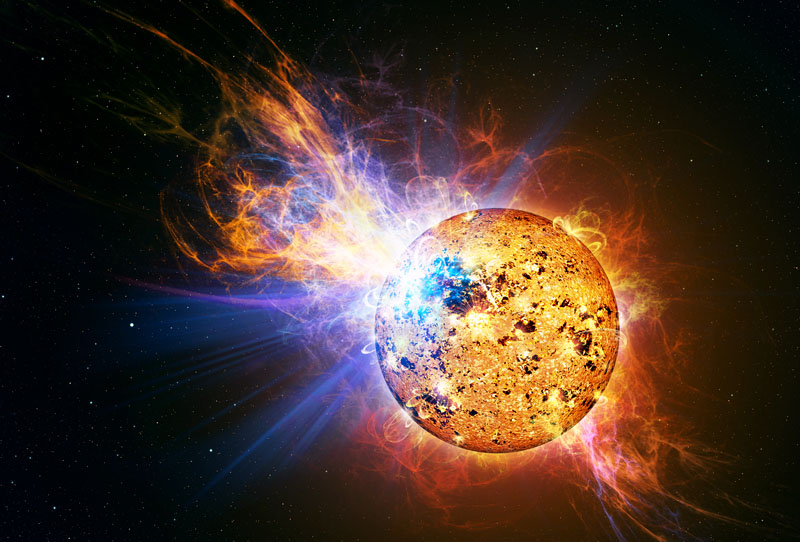
NASA’s Swift satellite picked up the brightest flare ever seen from a normal star other than our Sun. The flare, an explosive release of energy, packed the power of thousands of our typical solar flares. Flares of this magnitude could deplete the atmospheres of nearby life-bearing planets, sterilizing their surfaces.
Hubble Researchers Perplexed by Massive Compact Galaxies in the Early Universe

Astronomers looking at galaxies in the universe's distant past made a perplexing discovery when they found nine young, compact galaxies, each weighing in at 200 billion times the mass of the Sun. The galaxies, each only 5,000 light-years across, are a fraction of the size of today's grownup galaxies but contain approximately the same number of stars.
McDonald Observatory Seeks Facility Manager
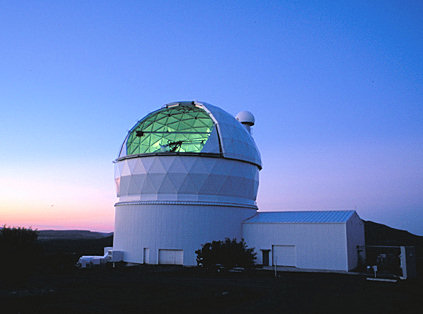
Here is someone's dream job!
Shuttle Servicing Mission to Keep Hubble in Top Form Until at Least 2013
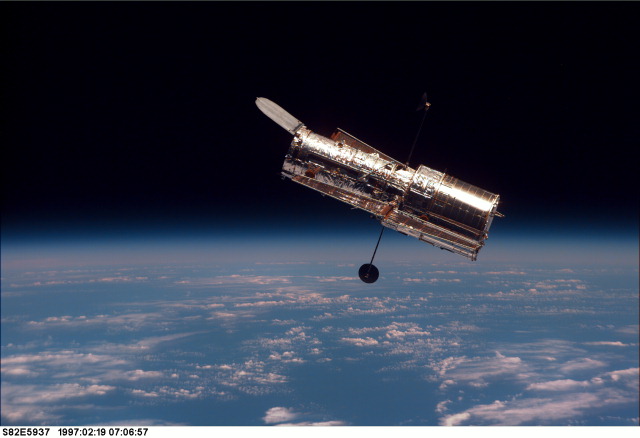
Atlantis STS-125, NASA's Shuttle Service Mission to the Hubble Space Telescope (HST), has been re-scheduled to end of September, 2008. During this fifth and final space shuttle servicing mission to Hubble, Atlantis' seven astronauts will repair and improve the orbiting observatory's capabilities, helping keep it in top form and productive until at least 2013.
XMM-Newton Discovers Part of the Missing Matter in the Universe
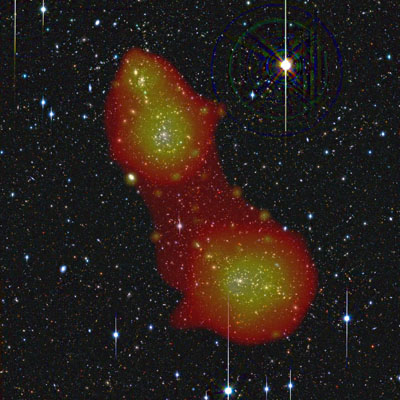
The latest resarch postulates that only about 5% of our universe is made of normal matter as we know it, consisting of protons and neutrons, or baryons, which along with electrons, form the building blocks of ordinary matter. The rest of our universe is composed of elusive dark matter (23%) and dark energy (72%). Astronomers using the European Space Agency (ESA) XMM (X-ray Multi-Mirror) Newton Observatory have now uncovered part of the missing matter in the universe.
Today the US Celebrates 47 Years of Manned Space Flight

Forty-seven years ago today, astronaut Alan B. Shepard, Jr. became the first American in space. At exactly 9:34 a.m. EST on May 5, 1961, about 45 million Americans sat tensely in front of their black and white television sets and watched a slim Redstone booster rocket with a small and cramped Mercury spacecraft manned by Alan Shepard, lift off its pad at Cape Canaveral and go roaring upward through the clear blue sky. Shepard's capsule, named Freedom 7, made the historic 15-minute suborbital flight, officially kicking off manned Project Mercury flights. With six manned flights from 1961 to 1963, Project Mercury's objectives were very specific: 1) to orbit a manned spacecraft around Earth, 2) to investigate man's ability to function in space, and 3) to recover both man and spacecraft safely -- a set of objectives it achieved with flying colors, thus opening the door for Projects Gemini and Apollo later in the decade.
Funding Member
