News
World's Most Powerful Telescope Opens Both Eyes

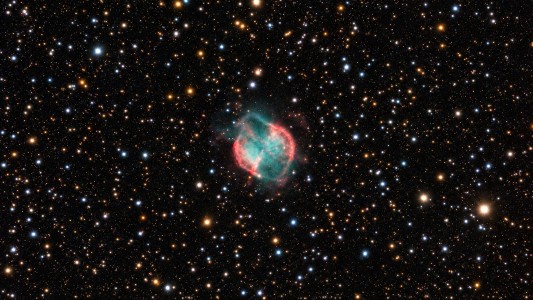
After more than a decade of preparation, the world’s most powerful telescope is now looking skyward with both of its massive eyes wide open. The Large Binocular Telescope (LBT), with its twin side-by-side, 8.4-meter (27.6 foot) primary mirrors, has successfully achieved first binocular light. The combined light from the two mirrors produce the image sharpness equivalent to a single 22.8-meter (75-foot) telescope. The LBT will provide new and more powerful views of deep space and help answer fundamental questions about the origins of the universe and the mysterious worlds in other planetary systems.
NASA Spacecraft Photographs Avalanches on Mars
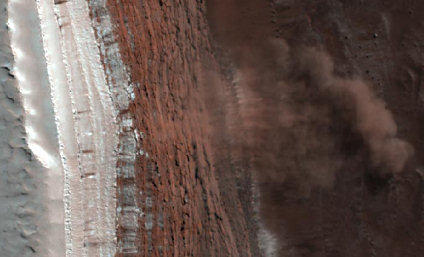
A NASA spacecraft in orbit around Mars has taken the first ever image of active avalanches near the Red Planet's north pole.
The Leap Year: Invented by the Egyptians, Implemented by Caesar, Perfected by a Pope
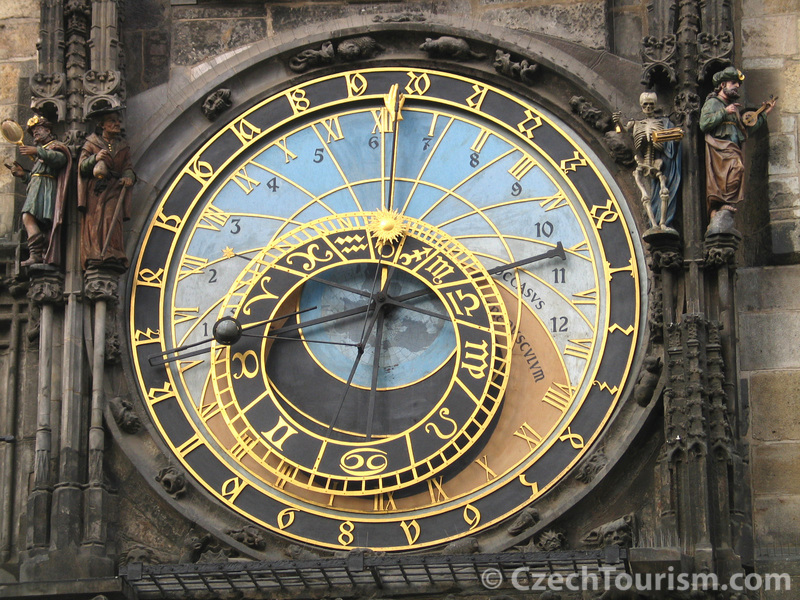
If you looked at your calendar yesterday, February 29th, you realized that 2008 is a leap year. Every four years, February has an extra day tagged on the end. How did this come about? It all starts with a simple fact of nature -- The Earth revolves around the Sun once every 365.242190 days. Now another question -- Why did the implementers of the leap year decide to add an extra day to February? An extra summer day in the month of June would have been much more appealing.
Microsoft Introduces WorldWide Telescope -- A Desktop Observatory
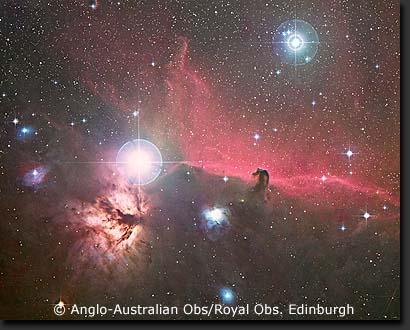
Microsoft introduced WorldWide Telescope (WWT) at the Technology Entertainment and Design (TED) Conference in Monterey, CA. WorldWide Telescope is an observatory on your desktop, allowing you to zoom in and out and see the sky in a new way. It brings together imagery from the best ground- and space telescopes to enable seamless, guided exploration of the universe.
MIT to Lead Development of Radio Telescope on the Far Side of Moon
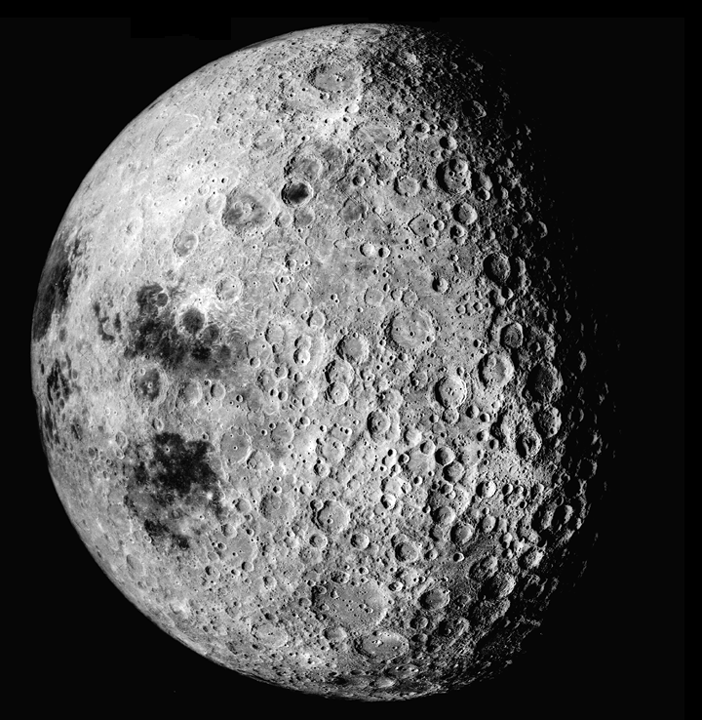
NASA has selected a proposal by an MIT-led team to develop plans for a huge two square kilometer radio telescope array on the far side of the moon that would probe the earliest formation of the basic structures of the universe. The Lunar Array for Radio Cosmology (LARC) telescope will pick up very-low-frequency radio emissions. Since the far side of the moon always faces away from the Earth, the radio telescope will never be exposed to interference from terrestrial radio transmissions. The array modules would be moved into place on the lunar surface by automated vehicles.
US Navy Shoots Down Errant Satellite
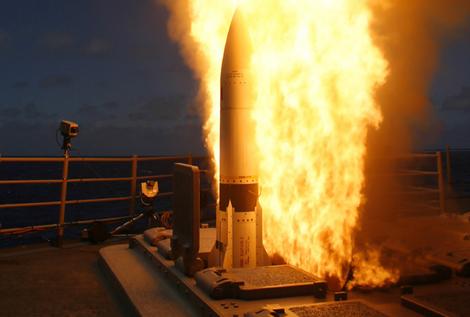
The US Navy shot down a malfunctioning US satellite on February 20, 2008 to prevent the possibility that it could release hydrazine, a toxic chemical, if it re-entered the atmosphere and crashed in a populated area. The USS Lake Erie (CG 70) launched the missile from the Pacific Ocean and intercepted the satellite at a point just above the atmosphere in order to bring it down in an unpopulated area. The satellite weighed 5,000 pounds. It is believed that roughly 2,800 pounds would have remained intact and survived re-entry if not intercepted.
View a Prime Time Total Lunar Eclipse on Wednesday Night
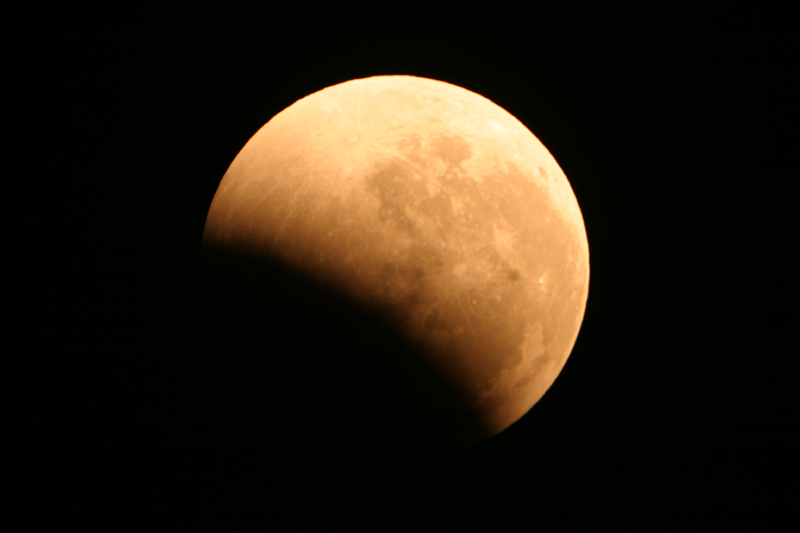
The full moon will turn an eerie color for several hours on the night of Wednesday, February 20, 2008 as it passes through Earth's shadow in a total lunar eclipse. The entire event will be visible from all of North and South America as well as Europe, Africa and western Asia. Viewers will see the moon's color gradually change from bright silver to dull copper as Earth's shadow engulfs it. This eclipse will be worth the effort to watch -- It will happen during convenient evening hours. The next total lunar eclipse won't happen until December 2010.
Hubble and Spitzer Find One of the Youngest and Brightest Galaxies in the Early Universe

NASA's Hubble and Spitzer space telescopes, with a boost from a natural "zoom lens," have uncovered what may be one of the youngest and brightest galaxies ever seen in the middle of the cosmic "dark ages," just 700 million years after the beginning of our universe. Astronomers estimate that the galaxy is 12.8 billion light-years away.
Light Echoes Used to Accurately Measure the Distance to a Cepheid Variable

A team of ESO astronomers have used Light Echoes to measure, to within a 1% precision level, the distance to a Cepheid Variable - a class of star that provides one of the basic measuring sticks in the cosmic distance scale.
Hubble Spots an Enormous Fossil Galaxy
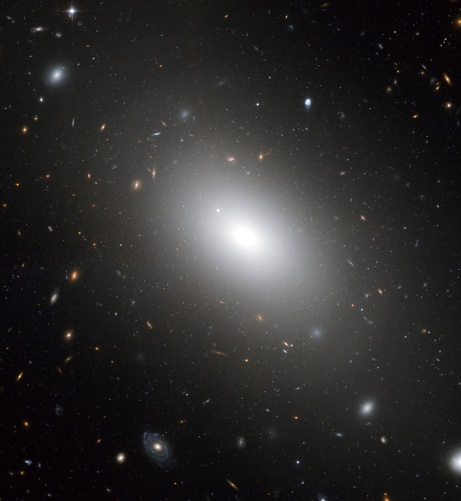
The NASA/ESA Hubble Space Telescope has captured a new image of the galaxy NGC 1132 which is, most likely, a cosmic fossil – the aftermath of an enormous multi-galactic pile-up, where the carnage of collision after collision has built up a brilliant but fuzzy giant elliptical galaxy far outshining typical galaxies. Located approximately 320 million light-years away in the constellation Eridanus, NGC 1132, together with the small dwarf galaxies surrounding it, are dubbed a “fossil group” as they are most likely the remains of a group of galaxies that merged together in the recent past.
ESO's Very Large Telescope Sheds New Light on Dark Energy
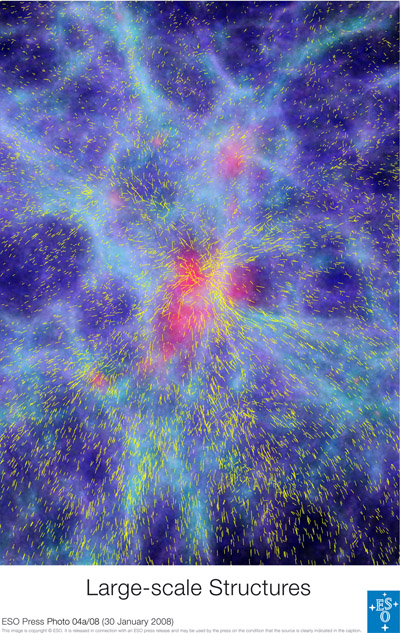
Astronomers have used the European Southern Observatory (ESO) Very Large Telescope (VLT) to measure the distribution and motions of thousands of galaxies in the distant Universe. This opens fascinating perspectives to better understand what drives the acceleration of the cosmic expansion and sheds new light on the mysterious dark energy that is thought to permeate the Universe.
NASA's MESSENGER Spacecraft Streams Back Surprises From Mercury
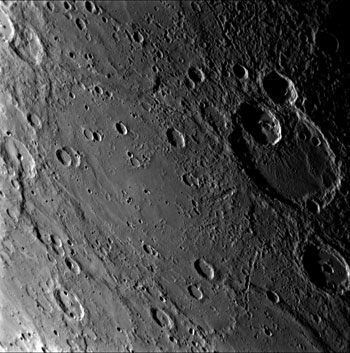
After a journey of more than 2 billion miles and three and a half years, NASA's MErcury Surface, Space ENvironment, GEochemistry, and Ranging (MESSENGER) spacecraft made its first flyby on Jan. 14, 2008. MESSENGER is the first mission sent to orbit the planet closest to our sun. The spacecraft's cameras and other sophisticated, high-technology instruments collected more than 1,200 images and performed the first up-close measurements of Mercury since the Mariner 10 spacecraft's third and final flyby on March 16, 1975. Researchers are amazed by the wealth of images and data that show a unique world with a diversity of geological processes and a very different magnetosphere from the one discovered and sampled more than 30 years ago.
Today the US Celebrates 50 Years of Space Exploration

With a brilliant flash and billowing smoke on the night of January 31, 1958, America's aspirations in space were dramatically unleashed in Cape Canaveral, Florida. The country had recently been humiliated when the Soviet Union put two Sputnik satellites in orbit in the fall of 1957. The wound deepened when a Navy-funded rocket called Vanguard exploded on the launch pad a few weeks later. The nation was ecstatic when the US successfully launch a Jupiter-C rocket carrying Explorer 1 -- the first United States satellite. The satellite not only salvaged national honor, but also yielded the first major scientific discovery of the space age: discovery of the Van Allen radiation belt surrounding the Earth.
Asteroid's Very Close Pass to Earth Tomorrow Night Should be Observable by Amateur Astronomers

Asteroid 2007 TU24 will closely approach the Earth to within 1.4 lunar distances (334,000 miles) on Jan. 29, 2008 at about 3:33 a.m. Eastern US time. This object, which is about 800 feet in diameter, will reach an approximate apparent magnitude of 10.3 before quickly becoming fainter as it moves further from Earth. For a brief time the asteroid will be observable in dark skies with amateur telescopes of 3 inch aperture or larger. Given the estimated number of near-Earth asteroids of this size (about 7,000), an object of this size would be expected to impact the Earth about once every 37,000 years.
Worlds Darkest Man Made Material Approaches Ultimate limit
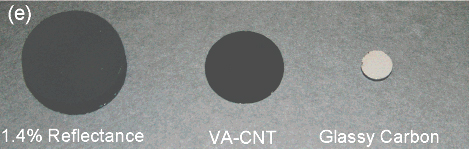
Materials Engineer Research Scientists at Rensselaer Polytechnic Report the manufactor of the World record for darkest man made material ever.
