News
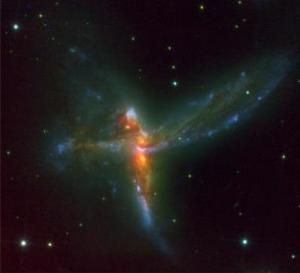
Cosmic Bird? Triple Cosmic Collision Of Galaxies Stuns Astronomers
Spectacular collision of 3 galaxies
USER ALERT - Please Read

More about the changes in email policy here at AstroMart - changes based on feedback and discussion with Astromart members.
Shuttle Repair To Delay European Space Lab Launch
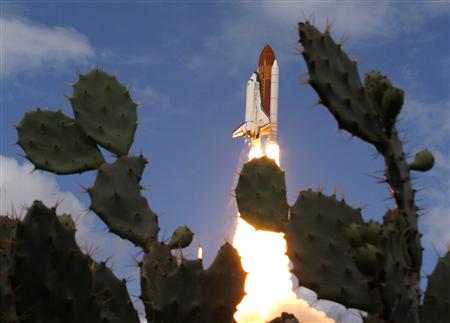
CAPE CANAVERAL, Florida (Reuters) - Repairing an electrical connection in a U.S. space shuttle's fuel tank will push the already delayed launch of Europe's first permanent space laboratory beyond the current target date of January 10th,
United Nations Proclaims 2009 the International Year of Astronomy

The United Nations has proclaimed 2009 the International Year of Astronomy (IYA). This is reminiscent of an earlier time and place -- the International Geophysical Year (IGY) of 1958, which launched many innovations and discoveries that directly led to the exploration of space.
Google Maps the Moon With NASA Images

New higher-resolution lunar NASA imagery and maps are now available on the Google Moon Web site. Google Moon's visible imagery and topography are aligned with the recently updated lunar coordinate system and can be used for scientifically accurate mission planning and data analysis.
ASTROMART USER ALERT - PLEASE READ

BIG CHANGE - There will no longer be email alerts for the classified ads.
Newly Discovered Asteroid Could Hit Mars Next Month
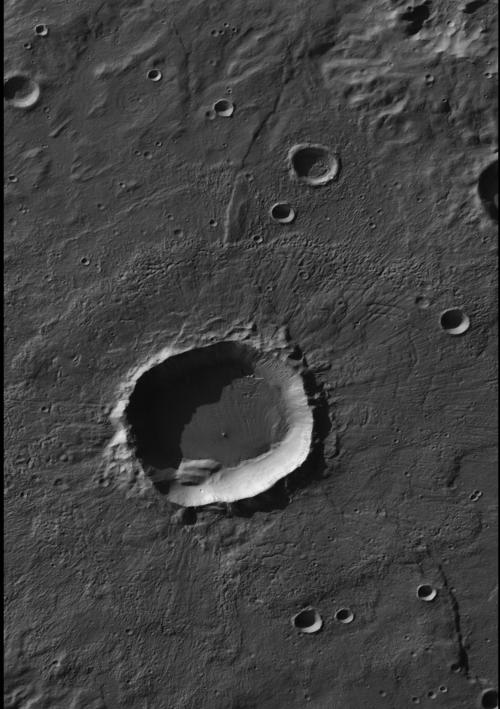
A recently discovered asteroid which passed close to the Earth in November, is now headed towards a very close passage by Mars and there is a small chance that it could hit that planet in late January 2008. The probability of a collision is only 1 chance in 75, but scientists are excited about the possibility.
And to all a good night!

A holiday greeting from Astromart and the Anacortes team.
Distant Galaxy Reveals Furious Star Formation
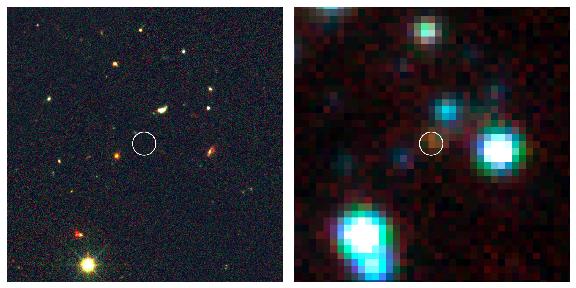
A furious rate of star formation recently discovered in a distant galaxy shows that galaxies in the early Universe developed either much faster or in a different way from what astronomers have thought. The galaxy, 12 billion light-years from Earth, is forming the equivalent of 4,000 Suns a year, which is a thousand times more violent than our own Milky Way Galaxy.
"Death Star' Galaxy Fires at Neighboring Galaxy
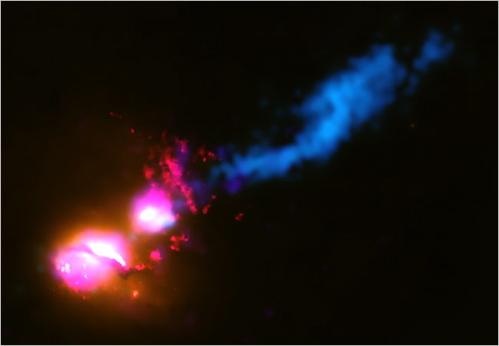
WASHINGTON - A powerful jet from a super massive black hole is blasting a nearby galaxy, according to new findings from NASA observatories. This never-before witnessed galactic violence may have a profound effect on planets in the jet's path and trigger a burst of star formation in its destructive wake. Known as 3C321, the system contains two galaxies in orbit around each other. Data from NASA's Chandra X-ray Observatory show both galaxies contain super massive black holes at their centers, but the larger galaxy has a jet emanating from the vicinity of its black hole. The smaller galaxy apparently has swung into the path of this jet.
Largest Digital Survey of the Milky Way Released
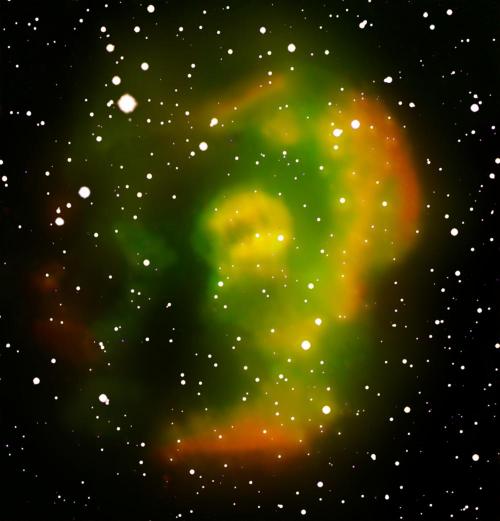
The deepest and most extensive survey of the Northern Galactic Plane of our Milky Way Galaxy has been released by a collaboration of more than 50 astronomers. To date, the IPHAS survey includes some 200 million unique objects in the newly released catalogue, some of which have never before been seen. Work to catalog the the southern hemisphere to start in the coming years.
NASA Sends Spacecraft To Comet Hartley 2 - October, 2010
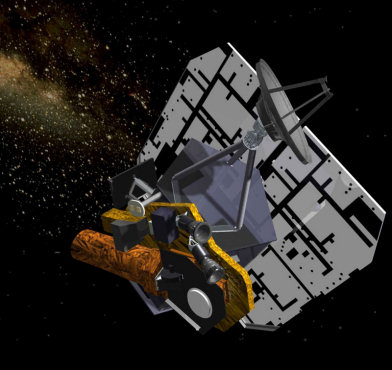
December 13, 2007 NASA has approved the retargeting of the Epoxi mission for a flyby of comet Hartley 2 on Oct. 11, 2010. Hartley 2 was chosen as Epoxi's destination after the initial target, comet Boethin, could not be found. Scientists theorize comet Boethin may have broken up into pieces too small for detection.
Boeing Wins $799.5 Million Contract For Moon Rocket

WASHINGTON - NASA on Wednesday awarded the Boeing Co. a $799.5 million contract to produce an avionics system that will control the Ares 1 rocket, which will be used to send astronauts back to the moon. The latest deal is the final major contract award for the program that will launch the Orion crew exploration vehicle into orbit by 2020.
Huge, Newfound Part of Milky Way Rotates Backwards
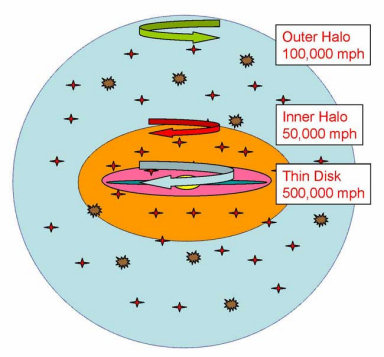
Our Milky Way Galaxy has two distinct parts in its outer reaches that rotate in opposite directions, astronomers announced today. The galaxy has a bulbous core where stars are tightly packed and orbiting rather furiously around the central black hole. Then there's the big flat disk with its spiral arms, also orbiting the galactic center somewhat in the manner of a hurricane's spiral bands. We live on one of those arms. Around it all is a halo of stars that don't all behave in such an orderly fashion. That much researchers knew. Now they find the halo has two parts.
Saturn's Rings May Be 4.5 Billion Years Old

SAN FRANCISCO, Calif. – New observations by NASA's Cassini spacecraft indicate the rings of Saturn, once thought to have formed during the age of the dinosaurs, instead may have been created roughly 4.5 billion years ago, when the solar system was still under construction.
