News
Hubble Captures Giant Storm Eruptions on Jupiter
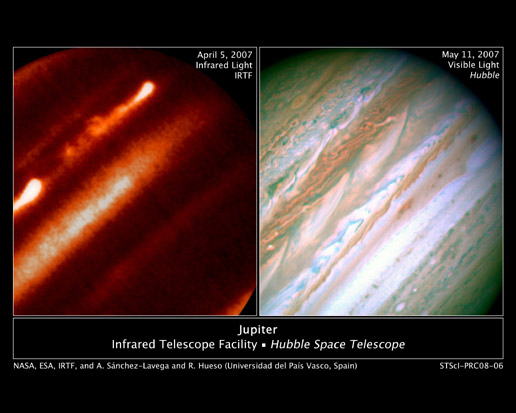
Detailed analysis of two continent-sized storms that erupted in Jupiter's atmosphere in March 2007 shows that Jupiter's internal heat plays a significant role in generating atmospheric disturbances. The new eruption of cloud activity and its evolution was monitored with unprecedented resolution using NASA's Hubble Space Telescope, the NASA Infrared Telescope Facility in Hawaii, and telescopes in the Canary Islands.
The Milky Way May Hold Hundreds of Rogue Black Holes
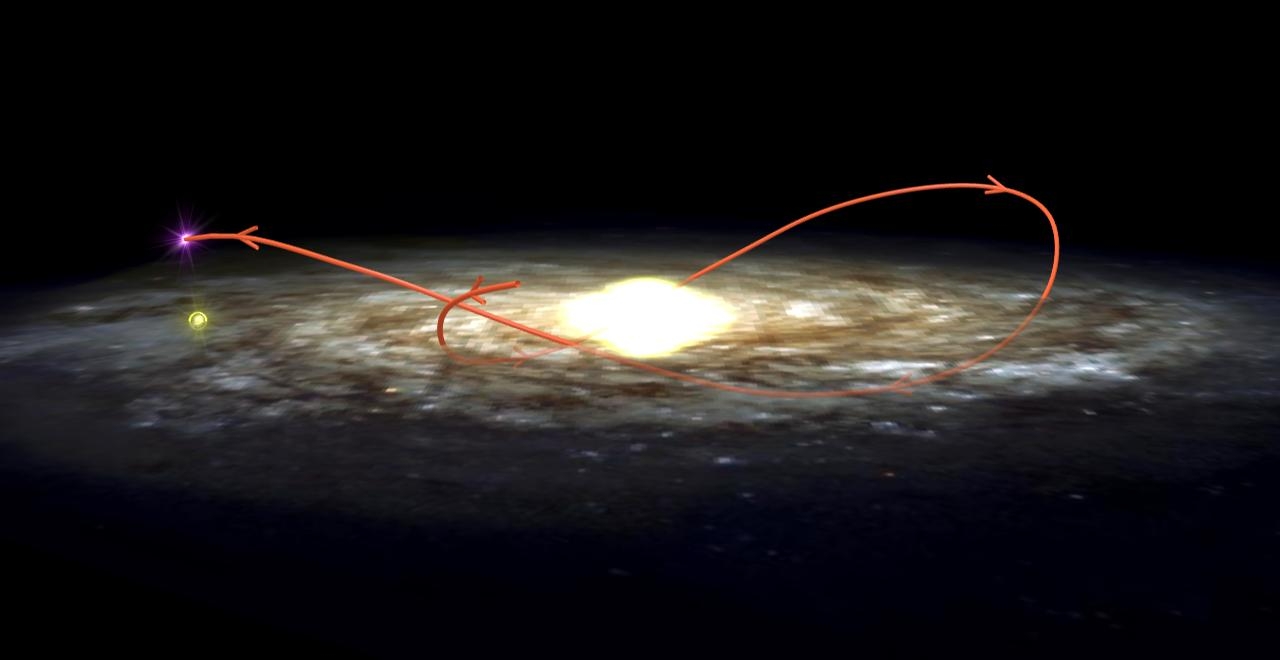
If the latest Vanderbilt University simulations of what happens when black holes merge are correct, there could be hundreds of rogue black holes roaming randomly around the Milky Way galaxy at high speeds. If the black holes are not swallowing a lot of gas to light them up, they may be nearly impossible to detect.
U of Chicago South Pole Telescope Searches for Dark Energy

Controlled remotely from the University of Chicago, the $19.2-million South Pole Telescope (SPT) has begun to search the southern polar heavens for shreds of evidence of dark energy. The discovery of dark energy in 1998 was completely unexpected. Understanding its nature is one of the biggest problems in physics. Scientists believe dark energy, which makes up 70 per cent of the Universe, is driving its accelerating expansion. If this expansion continues to accelerate experts say it could eventually lead to a Big Freeze as the Universe is pulled apart and becomes a vast cold expanse of dying stars and black holes - Oh dear...
A New Biography - “Copernicus’ Secret”

Nicolaus Copernicus stands in sharp contrast to the later giants of the scientific revolution. For Kepler, Galileo or Newton, biographers can draw on copious correspondence. Kepler complains to his former teacher that his son never writes home from college. Galileo protests that he can’t have his house arrest suspended to visit his doctor in Florence. For Copernicus, fewer than 20 letters survive.
An Inconvenient Galaxy: Arms Winding 'Backwards'
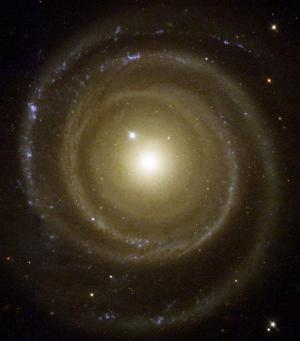
Discovery of two new components within a puzzling spiral galaxy confirm it must have a pair of arms winding in the opposite direction from most galaxies, according to new results. “While the existence of a galaxy with a pair of ‘backward’ arms may seem like an inconvenient truth to many, our latest analysis indicates it is, nonetheless, a reality,” says Dr. Gene Byrd, professor of astronomy at The University of Alabama. The galaxy, known as NGC4622, lies 200 million light years away in the constellation Centaurus.
Famous Space Pillars Feel The Heat Of Star's Explosion
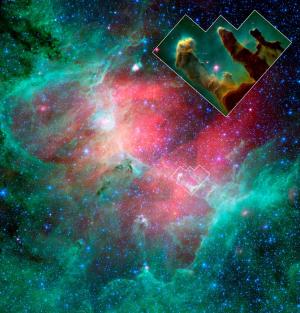
The three iconic space pillars photographed by NASA's Hubble Space Telescope in 1995 might have met their demise, according to new evidence from NASA's Spitzer Space Telescope. A new, striking image from Spitzer shows the intact dust towers next to a giant cloud of hot dust thought to have been scorched by the blast of a star that exploded, or went supernova.
Supernova Remnants Dance In The Large Magellanic Cloud
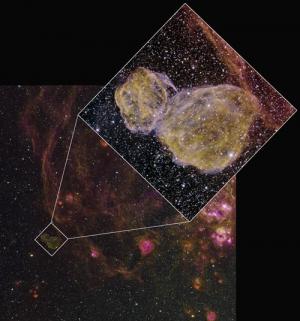
The Gemini South Multi-Object Spectograph (GMOS) recently captured a dramatic image of a vast cloud complex named DEM L316 located in the Large Magellanic Cloud. The peanut-shaped nebula appears to be a single object, but the latest research indicates that it is really comprised of two distinct gas and dust clouds formed by different types of supernova explosions.
Massive Gas Cloud Speeding Toward Collision With Milky Way!
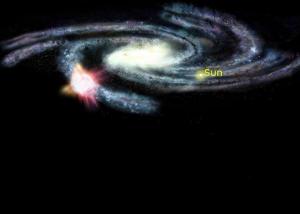
A giant cloud of hydrogen gas is speeding toward a collision with our Milky Way Galaxy, and when it hits -- in less than 40 million years -- it may set off a spectacular burst of stellar fireworks.
Hubble Helps Physicists Find ‘Double Einstein Ring'

Using the Hubble Space Telescope, University of Calfirnia - Santa Barbara (UCSB) scientists have discovered a never-before-seen optical alignment in space: a pair of glowing rings, one nestled inside the other like a bull's-eye pattern. The phenomenon is called a "double Einstein ring" and is a rare phenomenon that can offer insight into dark matter, dark energy, the nature of distant galaxies, and even the curvature of the universe.
Even Thin Galaxies Can Grow Fat Black Holes
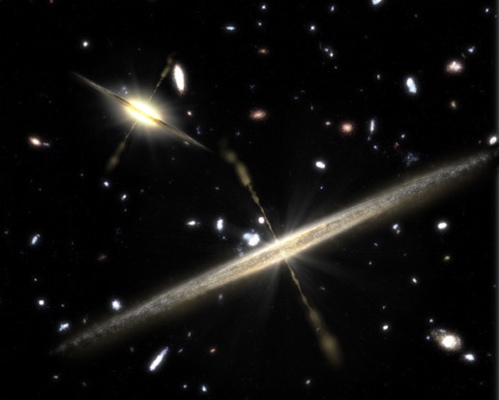
NASA's Spitzer Space Telescope has detected plump black holes where least expected -- skinny galaxies. Like people, galaxies come in different shapes and sizes. There are thin spirals both with and without central bulges of stars, and more rotund ellipticals that are themselves like giant bulges. Scientists have long held that all galaxies except the slender, bulgeless spirals harbor supermassive black holes at their cores. Furthermore, bulges were thought to be required for black holes to grow.
"Blue Blobs" in Space Are Orphaned Clusters of Stars
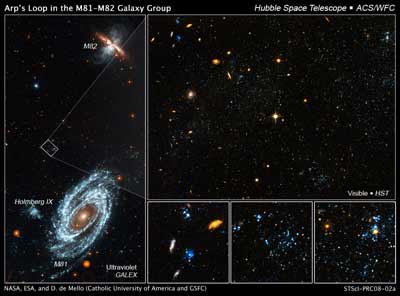
Hubble Space Telescope's powerful vision has resolved strange objects nicknamed "blue blobs" and found them to be brilliant blue clusters of stars born in the swirls and eddies of a galactic smashup 200 million years ago. Such "blue blobs" — weighing tens of thousands of solar masses — have never been seen in detail before in such sparse locations, say researchers. The "blue blobs" are found along a wispy bridge of gas strung among three colliding galaxies, M81, M82, and NGC 3077, residing about 12 million light-years away from Earth.
Polarized Light Brings Exoplanet Into View
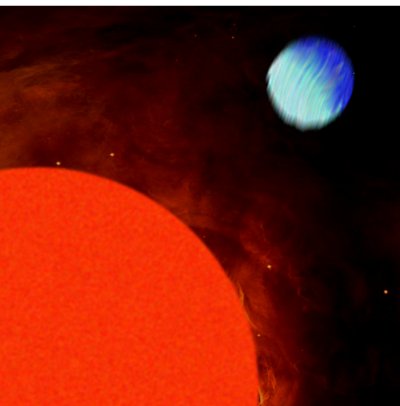
An international team of astronomers has made the first direct measurements of the visible light that is scattered in the atmosphere of an exoplanet. Polarization measurements allowed the scientists to infer the size of the planet's atmosphere, and to trace the orbit of the planet directly – a visualization feat that's not possible with indirect detection methods.
Hot Cyclones Churn at Both Ends of Saturn
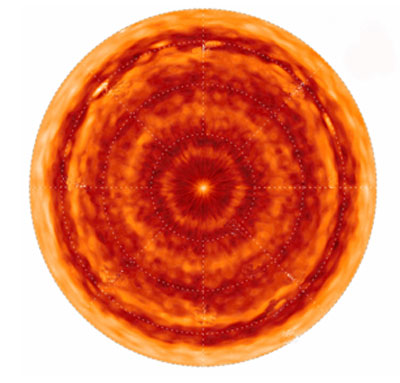
Despite more than a decade of winter darkness, Saturn's north pole is home to an unexpected hot spot remarkably similar to one at the planet's sunny south pole. The source of its heat is a mystery. Now, the first detailed views of the gas giant's high latitudes from the Cassini spacecraft reveal a matched set of hot cyclonic vortices, one at each pole.
New Year's Resolution -- Take Astronomy Courses at MIT... For Free

MIT's initiative to openly publish course content and make it available for free on the internet, appropriately named the "OpenCourseWare" (OCW)Program, celebrated a major milestone this past month. Core teaching materials--including syllabi, lecture notes, assignments, and exams from virtually all MIT courses -- 1,800 in total -- are now available online. Valuable course material is offered in Engineering, Architecture, Humanities, Management, Mathematics, Physics, Chemistry, Biology, and of course everyone's favorite -- Astronomy.
Hubble Space Telescope Photo at Mars' Closest Approach of 2007
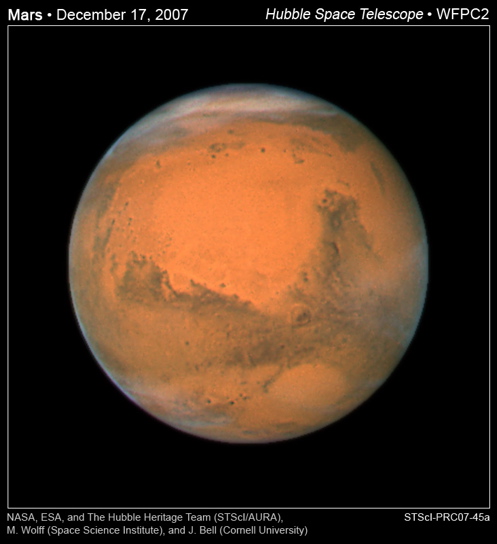
NASA's Hubble Space Telescope took this close-up of the red planet Mars when it was just 55 million miles - 88 million kilometers - away. This color image was assembled from a series of exposures taken within 36 hours of the Mars closest approach with Hubble's Wide Field and Planetary Camera 2.
