Reviews & Articles
Image of the day
About Astromart
My Account
New to Astromart?
Register an account...Need Help?
News
Astronomers discover mysterious new star clusters
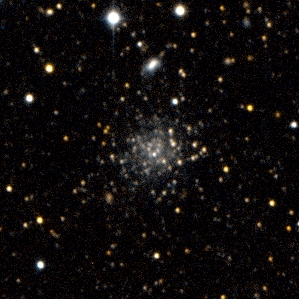
A UK-led team of astronomers has discovered a completely new type of star cluster around a neighboring galaxy. The new-found clusters contain hundreds of thousands of stars, a similar number to the so-called globular star clusters which have long been familiar to astronomers. <b>NOTE: French, German, Italian, and Spanish translations follow...</b>
Scientists Track Collision of Powerful Stellar Winds.
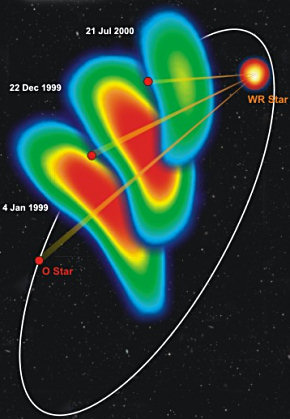
Astronomers using the National Science Foundation's Very Long Baseline Array (VLBA) radio telescope have tracked the motion of a violent region where the powerful winds of two giant stars slam into each other. <b>NOTE: French, German, Italian, and Spanish translations follow...</b>
Does this 4" Achromat make the grade?

This week's review contest winner takes a peek through the Orion F/6 Astroview 100mm EQ...
Study Shows Early Earth Atmosphere Hydrogen-Rich, Favorable To Life.
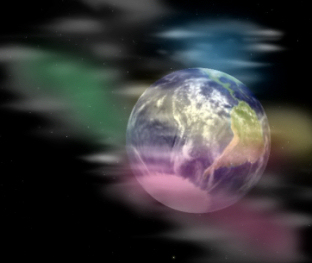
A new University of Colorado at Boulder study indicates Earth in its infancy probably had substantial quantities of hydrogen in its atmosphere, a surprising finding that may alter the way many scientists think about how life began on the planet. <b>NOTE: French, German, Italian, and Spanish translations follow...</b>
Explosions in Space May Have Initiated Ancient Extinction on Earth.

Scientists at NASA and the University of Kansas say that a mass extinction on Earth hundreds of millions of years ago could have been triggered by a star explosion called a gamma-ray burst. The scientists do not have direct evidence that such a burst activated the ancient extinction. The strength of their work is their atmospheric modeling -- essentially a "what if" scenario. <b>NOTE: French, German, Italian, and Spanish translations follow...</b>
Old Star's "Rebirth" Gives Astronomers Surprises.
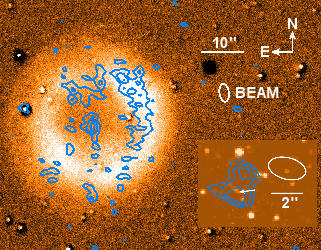
Astronomers using the National Science Foundation's Very Large Array (VLA) radio telescope are taking advantage of a once-in-a-lifetime opportunity to watch an old star suddenly stir back into new activity after coming to the end of its normal life. Their surprising results have forced them to change their ideas of how such an old, white dwarf star can re-ignite its nuclear furnace for one final blast of energy. <b>NOTE: French, German, Italian, and Spanish translations follow...</b>
Era of Galaxy and Black Hole Growth Spurt Discovered

Distant galaxies undergoing intense bursts of star formation have been shown by NASA's Chandra X-ray Observatory to be fertile growing grounds for the largest black holes in the Universe. Collisions between galaxies in the early Universe may be the ultimate cause for both the accelerated star formation and black hole growth. <b>NOTE: French, German, Italian, and Spanish translations follow...</b>
A C-Mak gets the once over in this week's winner...

The Celestron C130 5.1 inch Maksutov OTA makes a debut here in the AstroMart reviews and the author takes this week's prize.
This is a follow-up to the Deep Impact Status report posted here last week on March 26.
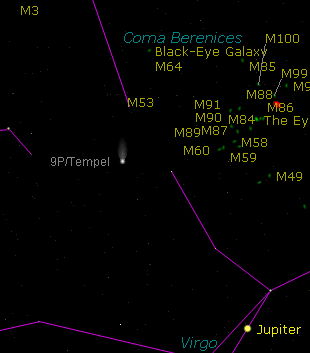
The University of Maryland has posted a web page asking for amateur support on this mission. If you are an imager, you might want to give this a look. <b>NOTE: French, German, Italian, and Spanish translations follow...</b>
NASA Announces First Centennial Challenges' Prizes.
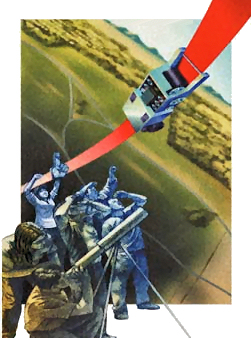
NASA and its partner, the Spaceward Foundation, today announced prizes totaling $400,000 for four prize competitions, the first under the agency's Centennial Challenges program. <b>NOTE: French, German, Italian, and Spanish translations follow...</b>
An exciting new development in astro gear...

From time to time, we like to alert AstroMart members to interesting product releases and we are thrilled to announce an exciting newcomer to the ranks of telescope manufacturers...
Another Hubble revelation
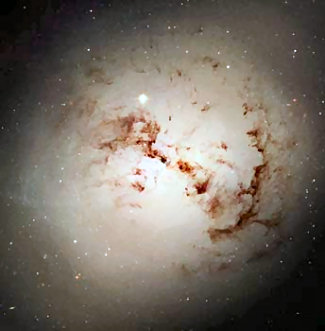
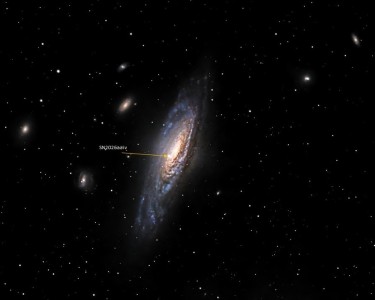
This image made from data obtained with the NASA Hubble Space Telescope reveals the dust lanes and star clusters of this giant galaxy that give evidence that it was formed from a past merger of two gas-rich galaxies. <b>NOTE: French, German, Italian, and Spanish translations follow...</b>
Good review of a scope that needs some help...

Not all scopes are perfect and not all copies of the same scope share the same quality and this week's review winner covers one that could use some quality control...
New Frontier Opens In The Search For Life On Other Planets.
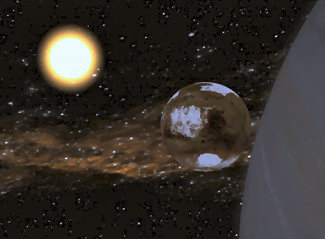
Scientists recently discovered a new frontier in the race to find life outside our solar system. Dying red giant stars may bring icy planets back from the dead. Once-frozen planets and moons may provide a new breeding ground for life as their stars enter the last, and brightest, phase of their lives. Previous ideas about the search for extra-solar life had excluded these regions. <b>NOTE: French, German, Italian, and Spanish translations follow...</b>
NASA Releases Deep Impact Mission Status Report
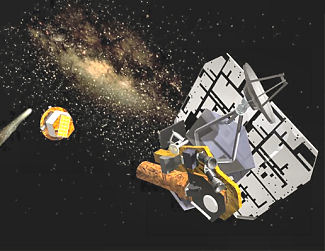
NASA's Deep Impact spacecraft completed the commissioning phase of the mission and has moved into the cruise phase. <b>NOTE: French, German, Italian, and Spanish translations follow...</b>