News
New NASA Mission To Reveal Moon's Internal Structure And Evolution
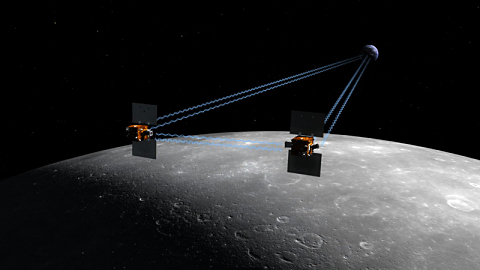
The Gravity Recovery and Interior Laboratory, or Grail, mission is a part of NASA's Discovery Program. It will cost $375 million and is scheduled to launch in 2011. Grail will fly twin spacecraft in tandem orbits around the moon for several months to measure its gravity field in unprecedented detail.
Microbes May Threaten Lengthy Spaceflights
With NASA now actively planning for the day when astronauts will live for months on the moon or make the years-long flight to Mars and back, a potentially troublesome question is being raised with increasing urgency: Is the human body -- even a well-protected human body -- capable of living in space for long periods without suffering serious damage?
Images of Saturn's Small Moons Tell the Story of Their Origins
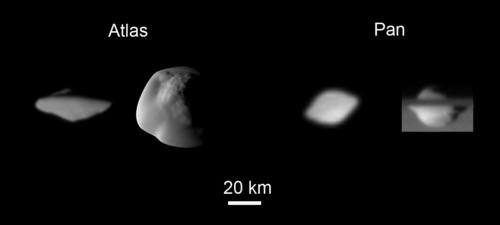
These high resolution images of Pan and Atlas reveal distinctive "flying saucer" shapes created by prominent equatorial ridges not seen on the other small moons of Saturn. Imaging scientists on NASA's Cassini mission are telling a tale of how the small moons orbiting near the outer rings of Saturn came to be. The moons began as leftover shards from larger bodies that broke apart and filled out their "figures" with the debris that made the rings.
NASA to Probe Self for UFO data
A federal ruling requires the space agency to turn over any files it might have related to a 1965 incident in a small Pennsylvania town. KECKSBURG, Pa. - The U.S. government says nothing of note happened in this small town in the hills of southwestern Pennsylvania at 4:47 p.m. on Dec. 9, 1965. A meteor may have passed by, but no alien ship or Russian space probe fell to Earth, as many here believe.
Japan's Hinode Satellite Shows How Magnetic Waves and X-Ray Jets Drive Solar Wind into Space
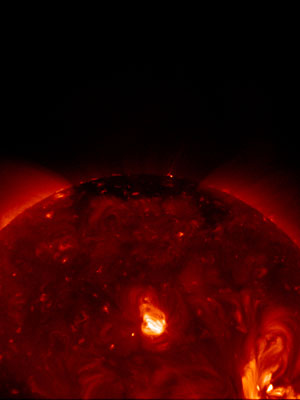
The solar wind is a stream of electrically charged gas that is propelled away from the Sun in all directions at speeds of almost 1.5 million km/h and can disrupt power grids, satellites, and communications on Earth. How the solar wind is formed and powered has been the subject of debate for decades. Spectacular images and data from the Japan Aerospace Exploration Agency (JAXA) Hinode spacecraft have shed new light on the Sun's magnetic field and the origins of solar wind.
One Last Ride to the Hubble
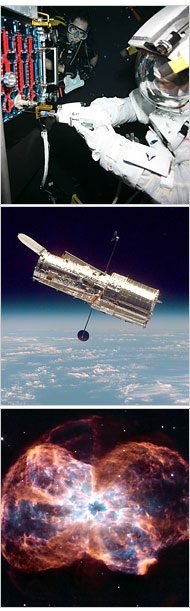
Next August, after 20 years of hype, disappointment, blunders, triumphs and peerless glittering vistas of space and time, and four years after NASA decided to leave the Hubble Space Telescope to die in orbit, setting off public and Congressional outrage, a group of astronauts will ride to the telescope aboard the space shuttle Atlantis with wrenches in hand.
Discovering Teenage Galaxies -- ESO's VLT Takes the Search for Young Galaxies to New Limits
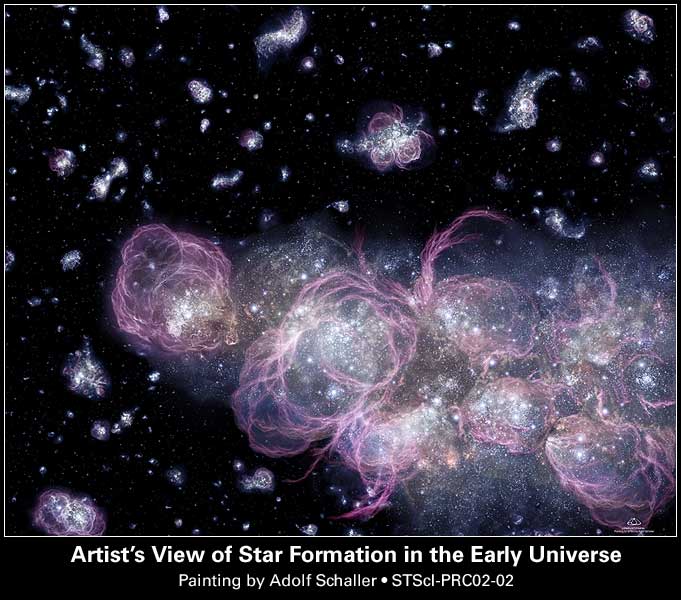
Staring for the equivalent of every night for two weeks at the same little patch of sky with ESO's Very Large Telescope (VLT), an international team of astronomers has found the extremely faint light from teenage galaxies billions of light years away. These galaxies, which the research team believes are the building blocks of normal galaxies like our Milky Way, had eluded detection for three decades, despite intensive searches.
Csomic Cannonball Moves at 3 Million MPH !

Washington, Nov 29: Astronomers have discovered one of the fastest moving (neutron) stars with NASA's Chandra X-Ray Observatory.
NEWS@SKY (Space&Science)

The NEWS@SKY (Space&Science) is a unique opportunity to browse hundreds of scientific and popular science Internet sites without a single mouse click!
Hubble Ultra Deep Field on SKY-MAP.ORG

For the first time, SKY-MAP.ORG was able to present the famous Hubble Ultra Deep Field on the Internet using a visual form, convenient for browsing on a regular monitor screen. The SKY-MAP.ORG technology makes it possible to view this image at any scale.
Did the Dino-Meteor Have Help From a Super Volcano?
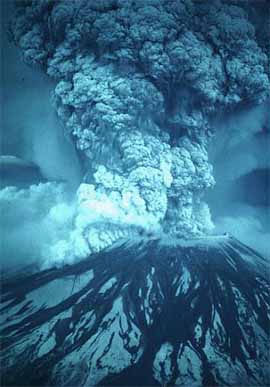
A series of monumental Super Volcanic eruptions in India may have killed the dinosaurs 65 million years ago, not a meteor impact in the Gulf of Mexico. The eruptions, which created the gigantic Deccan Traps lava beds of India, are now the prime suspect in the most famous and persistent paleontological murder mystery, say scientists who have conducted a slew of new investigations honing down eruption timing.
Auger Observatory Links Highest-Energy Cosmic Rays with Violent Black Holes

Scientists of the Pierre Auger Observatory in Argentina announced that Active Galactic Nuclei (AGN) are the most likely candidates for the source of the highest-energy cosmic rays that hit Earth. A team of scientists from 17 countries found that the sources of the highest-energy particles are not distributed uniformly across the sky. Instead, the Auger results link the origins of these mysterious particles to the locations of nearby galaxies that have active nuclei in their centers. The Pierre Auger Observatory, the largest cosmic-ray observatory in the world, has been collecting data since early 2004.
Planetary Society Urges Congress to Save Arecibo
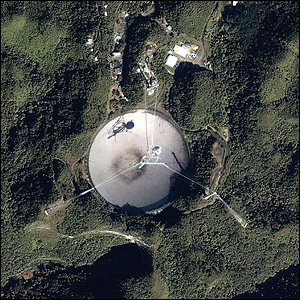
Yesterday, the Planetary Society submitted a statement to the Committee on Science and Technology urging the US Congress to prevent Earth's largest radio telescope -- Arecibo -- from closing due to lack of funds. Near Earth Objects (NEOs) have struck Earth with devastating results in the past. Radar tracking is the only way to precisely know the probability of impact, and the Arecibo telescope is the most powerful instrument for the job, 20 times more sensitive for NEO radar tracking than any other instrument in the world. The Planetary Society believes that the closing of Arecibo, due to lack of funds, may leave the planet more vulnerable to a future meteorite impact.
The Pleasures of the Wide Field

This review contest winner steps back to take in the Mandel Wide Field Adapter System.
Two Records in Two Weeks -- Heaviest Stellar Black Holes on Record Discovered
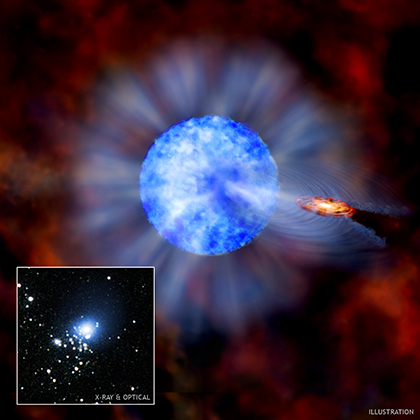
Astronomers have discovered a stellar black hole that is is almost 16 times the Sun's mass revolving around a star that is about 70 times more massive than the Sun. Sixteen times the Sun's mass is a record for black holes created from the collapse of a giant star. "Super Massive" Black Holes at the centers of galaxies are much more massive, but this object, X-7 in M33, is the record-setter for so-called "Stellar Mass" black holes. (SEE NEWS FLASH BELOW -- DISCOVERY OF A NEW RECORD STELLAR MASS BLACK HOLE WAS JUST ANNOUNCED YESTERDAY)
